
The Living GTM System
Know what changed. Understand what it affects. Decide what to change next.
See what new evidence changes, and which parts of your GTM it affects, before you approve anything.
Free · runs in Claude · your strategy stays in one file you own.

The drift loop
Your strategy is everywhere, and it's drifting.
Your ICP sits in Notion, your positioning in the pitch deck, and what customers actually said in call notes. LinkedIn posts get written in ChatGPT from whatever you remember that day.
Every new message drifts a little further from what you decided. Nobody chose to change the strategy; it just stopped matching what you say.
A strategy is more than disconnected documents.
Contexl turns them into one Living GTM System:
Your customers, jobs, product, competitors and offers in one connected model, with one vocabulary.
Your strategy is revisited when the evidence changes, and every claim says how sure you can be.
Every decision is kept with its reason, including the ones you put off.
How it works: the control loop
New evidence in. Your decision. Everything follows.
- 1SignalA customer call, a lost deal, a competitor move: you bring it in.
- 2Impact analysisContexl shows every part of your strategy it touches, and proposes a change.
- 3You approveNothing changes until you say so.
- 4Outputs refreshedBattle cards, messages and drafts built on the old version are flagged for an update.
- 5LearningThe decision and its reason are kept, and later outputs draw on what you approved or rejected.
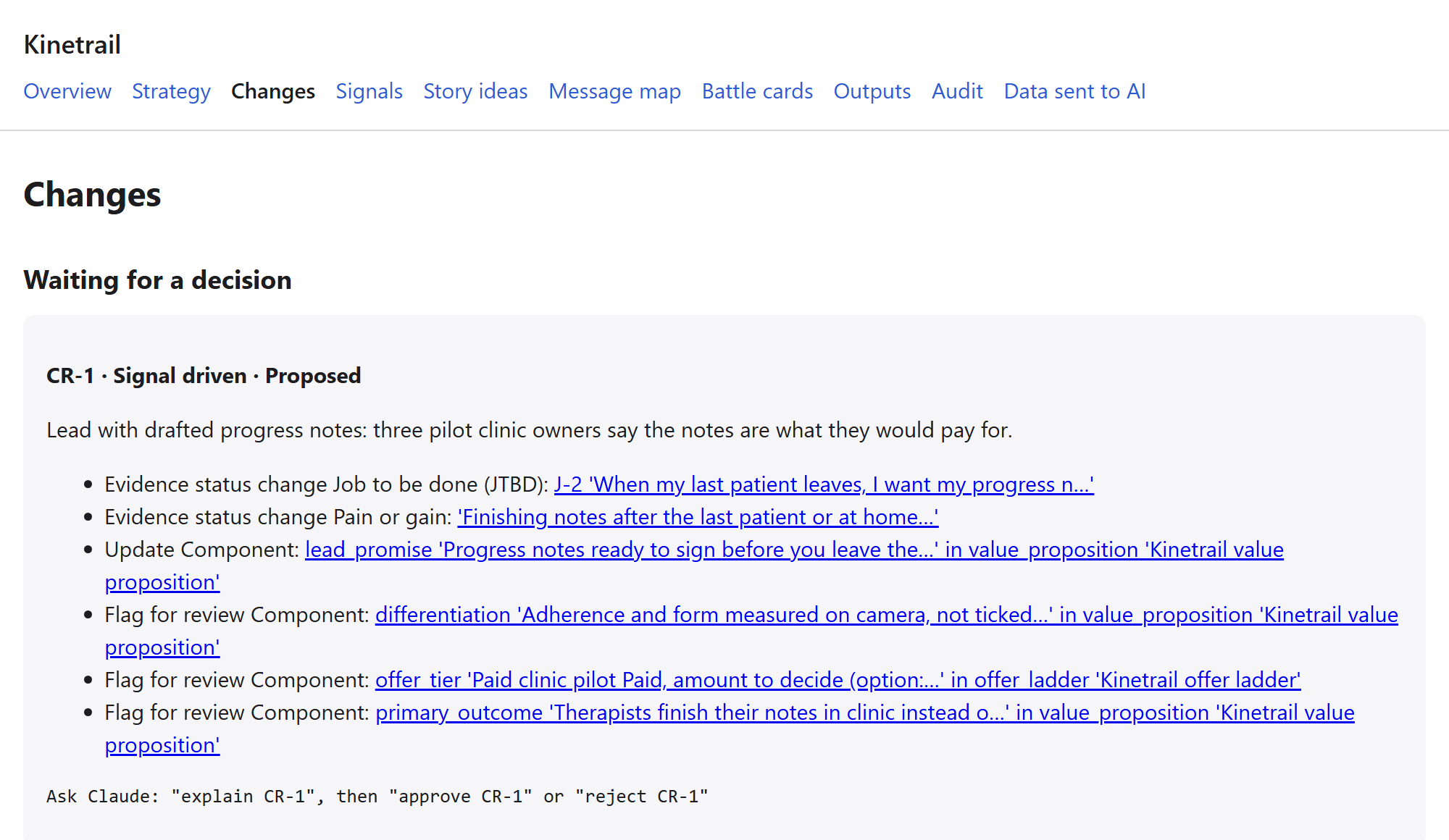
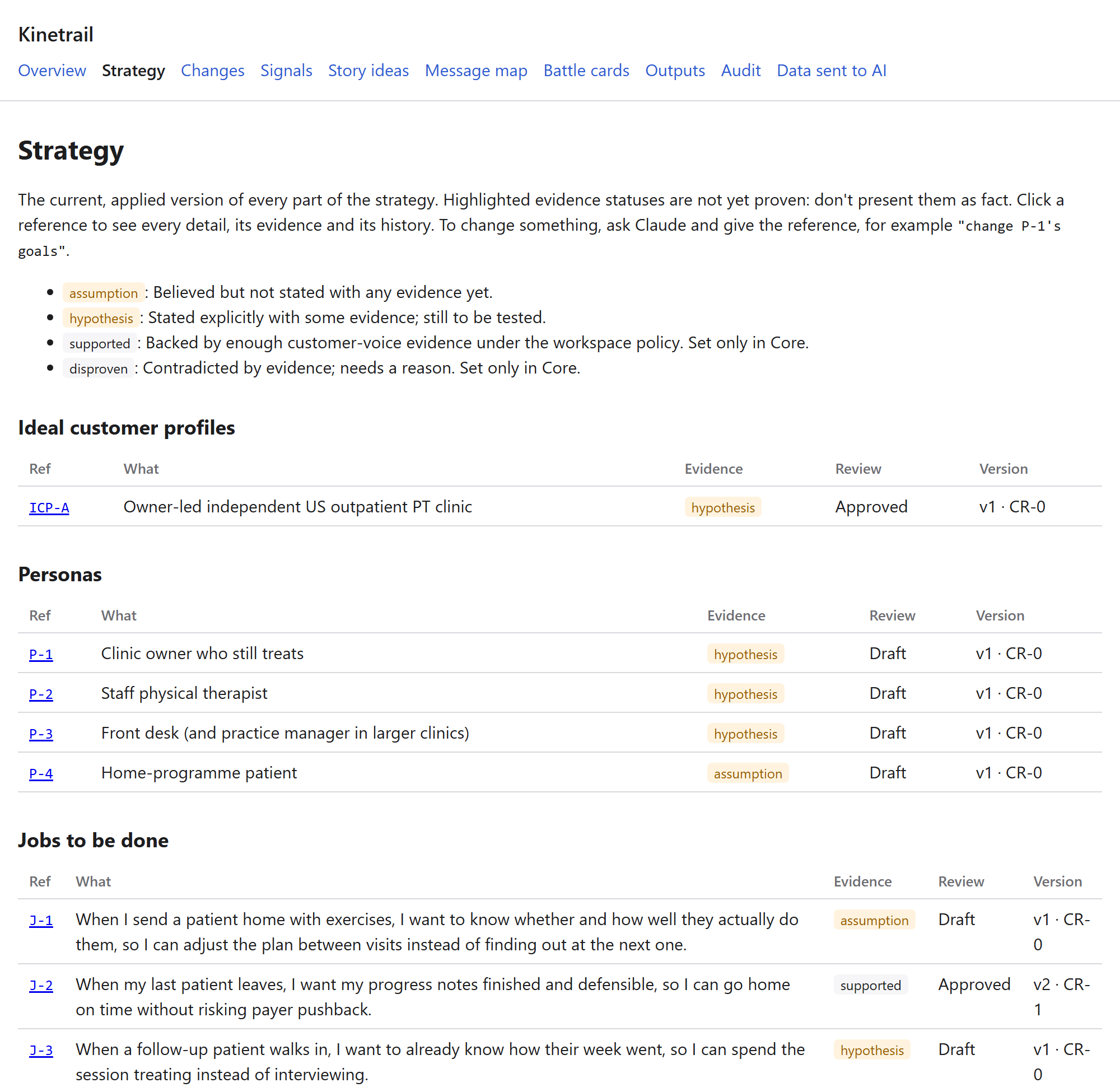
Real screens from Contexl Core, with Kinetrail, an invented startup. Click any screen to open it; every item in the report opens its own page.
Start free: the GTM Architect (Claude skill)
Build your GTM strategy in your own Claude
It asks the questions; you answer in your own words. Together you build:
- your product profile and features
- your ideal customer profile (ICP) and two personas
- the jobs your customers hire you for
- your competitors
- your value proposition and offer ladder
After that, bring in a signal or a document, and it shows which parts of your strategy it affects. Everything stays on your side; nothing is sent to Contexl.
USEFUL ON ITS OWN
A documented strategy every AI tool can read
You keep your strategy as two files: a readable document, and a structured file in which every part is labelled, linked to the others and marked with how sure you are.
Add it to a Claude project, give it to another skill or prompt, paste it into ChatGPT, or share it with your team. Whatever you write next starts from the same strategy, whether or not you ever use Core.
Install it in three steps
- Download the skill (a .zip file; don't unzip it).
- In Claude, go to Settings → Capabilities and turn on code execution (Code execution and file creation, called Create and edit files in newer layouts). On a Team or Enterprise plan, your admin may need to allow skills.
- Go to Customize → Skills, click +, then Create skill → Upload a skill, and choose the .zip file. Then start a new chat: "Let's work on my GTM strategy."
Works in Claude on the web or in the desktop app. Built for B2B software companies. Free to use; please don't redistribute or resell it.
Living GTM Core
When your strategy has to keep up
The free Skill gives you a strategy. Core keeps it alive while you sell, talk to customers and publish.
A week with Core
You talk to customers
Paste your call notes or transcripts. Core links each one to the right company and contact, and turns what people said into quoted signals.
Your competitors move
Once a week, Core's competitor analysis goes through what they changed (site, pricing, posts, ads, news) and ranks what matters.
Core shows what's affected
For every signal: which parts of your strategy it touches, from ICP and personas to messages and content, with a proposed change.
You decide
Nothing changes until you approve it. Every decision is kept with its reason, including the ones you put off.
Your outputs follow
Core shows which battle cards, messages and drafts are now out of date, and offers to refresh them.
CORE KEEPS WATCH
From what's changing out there to your next story
Sources you choose
For each competitor: their website and pricing, ads, company posts, news, and funding and filings. Plus your own calls. Core keeps the list and flags a source nobody has checked lately.
Signals and themes
The weekly run turns what changed into signals. Similar signals group into themes, with how strong the evidence is and whose voice it is: customers, prospects, competitors or experts.
Story ideas
From the themes you review, Core proposes story ideas within your content pillars and scores them. Approve one and get a content brief, or a draft in your own voice.
Today the weekly run collects through Claude's web search, or from what you paste in. Automatic collection through connectors is on the roadmap.
What you get
Working with your strategy
- Your free Architect strategy, imported in one step
- Call notes and transcripts turned into quoted signals
- Jobs-to-be-done evidence that builds up across signals
- Impact analysis and proposed changes for you to approve
- The Variant Ledger: every change and its reason
- A report of your whole strategy you open in any browser, with a page per item
- An audit that checks every link
Outputs that work now
- Weekly competitor analysis
- Battle cards: how to win against each competitor, including "doing nothing" and "we'll build it ourselves"
- Message map: what to say to each persona in each type of company
- Content drafts: LinkedIn posts, blog posts and how-tos from your story ideas, in English or Dutch, in your own voice
- Context packs: your current strategy for the AI tools you already use
Your accounts
- Customers and target accounts, checked against your ICP and personas
- When you change your ICP, Core shows which accounts no longer fit, before you approve
| Free GTM Architect | Living GTM Core | |
|---|---|---|
| Build your strategy | ✓ | ✓ (imports it) |
| A documented strategy any AI tool can read | ✓ two files you keep | ✓ plus context packs per reader and offer |
| Bring in a signal, see what it affects | ✓ one at a time | ✓ plus calls and the weekly competitor analysis |
| Proposed changes you approve | ✓ | ✓ with impact on messages, content and accounts |
| Sources watched, signals grouped into themes, story ideas | – | ✓ |
| Variant Ledger | – | ✓ |
| Battle cards, message map, content drafts | – | ✓ |
| Accounts and ICP fit | – | ✓ |
| Runs in | Claude (web or app) | Claude Code (desktop app) |
YOURS TO KEEP
$2,500, one-time. A perpetual licence.
- Use it forever. Your licence never expires, and the version you have keeps working.
- 12 months of updates included: new versions, new outputs and improvements for a full year.
- After the first year, keep using your version as long as you like. Continued updates come with the optional Intelligence Circle.
- Your data is always yours: one file you can open and export without Contexl.
- One licence covers one company and one product, for your whole team.
GUIDED ACTIVATION
+ $2,500
Four working sessions with Michael, with a set agenda and homework in between, so Core runs on your real strategy and customer conversations. Core and Guided Activation together: $5,000.
What you need: Claude Code, in the Code tab of the Claude desktop app, on a Claude Pro, Max, Team or Enterprise plan. Your data lives in one SQLite file that stays readable without Contexl.
Where it stands: Core is in its first release, for design partners. Every part is built and tested on sample data; design partners are the first to run it on their own strategy.
Talk to Michael about CoreWhy Contexl runs on your computer
Your GTM strategy should live with you
It's one of the most sensitive things your company has. It shouldn't live on another vendor's server.
Your strategy stays yours
One file on your computer. No Contexl account, no hosted copy. Back it up, move it, open it without Contexl.
You use the AI you already pay for
Contexl works through your own Claude subscription. No extra AI fee, and your strategy goes only to the AI you already use, under your own account.
It works where you already work with AI
You change your strategy by telling Claude what happened. You don't need to code. Contexl checks each change, shows its impact and records it.
That's why it's a one-time price
We don't run your data on our servers, so there's no monthly fee just to keep access.
Local doesn't mean do-it-yourself
Contexl is maintained software with a method behind it. Local is where it runs, not who builds it.
Why Claude Code
Core runs in Claude Code, in the Code tab of the Claude desktop app. Here's what that gives you:
It works with your files, not just a chat
Drop in call notes, transcripts, a deck or a competitor's pricing page. Contexl reads them from your folder; no copying and pasting.
Real software checks the AI's work
Claude doesn't edit your strategy directly. It calls Contexl's own commands, which check every change, walk every link to show the impact, and refuse anything that breaks the rules.
Nothing happens without your OK
Claude Code shows what it's about to do and asks first. Contexl adds its own approval step: no strategy change counts until you approve it.
One install gives you the whole set
Strategy, call notes, competitor analysis, battle cards, message map, content drafts and founder voice, working together on the same strategy.
Your other AI work stays on strategy too
Any skill or prompt you already use in Claude can read your current strategy from Contexl, so what you write elsewhere doesn't drift.
You pay for AI once
Your Claude plan covers it. No second AI subscription.
Claude Code sounds technical, but in the desktop app it's a chat window: you talk, Contexl does the structured work. The free Skill is lighter still and runs in ordinary Claude. And Contexl isn't tied to Claude for good: its commands are plain Python.
Why it's different
Built for founders who want to know, not guess
Know how sure you are
Every claim is marked as an assumption, a hypothesis, or supported by what customers said.
See the impact before you approve
Messages, offers, content ideas and which accounts stop fitting, before anything changes.
Your machine, your AI
It runs on your own computer, with your own Claude.
Decisions with memory
Decisions are kept with their reasons, including the ones you put off. This is the Variant Ledger from the book.
The Variant Ledger
Your GTM memory: what you decided, why, and what came of it
From The Content Value Chain: not a log of chats or a folder of old versions, but a record of every decision and every output that you can trace back and learn from. Core keeps it for you, from the first change.
Every change to your strategy
The signal that started it, the evidence, everything it touched, who approved it and why. Old versions are kept, never overwritten.
The decisions you put off
Deferred with a reason and a date to look again, so they come back instead of getting lost.
How every output was made
Which version of your strategy each battle card, message map, brief or draft was built on, so you know when it's out of date.
What your outputs taught
Examples to follow and mistakes to avoid, each with its reason, shown to the next battle card or message map Core drafts.
What it's good for
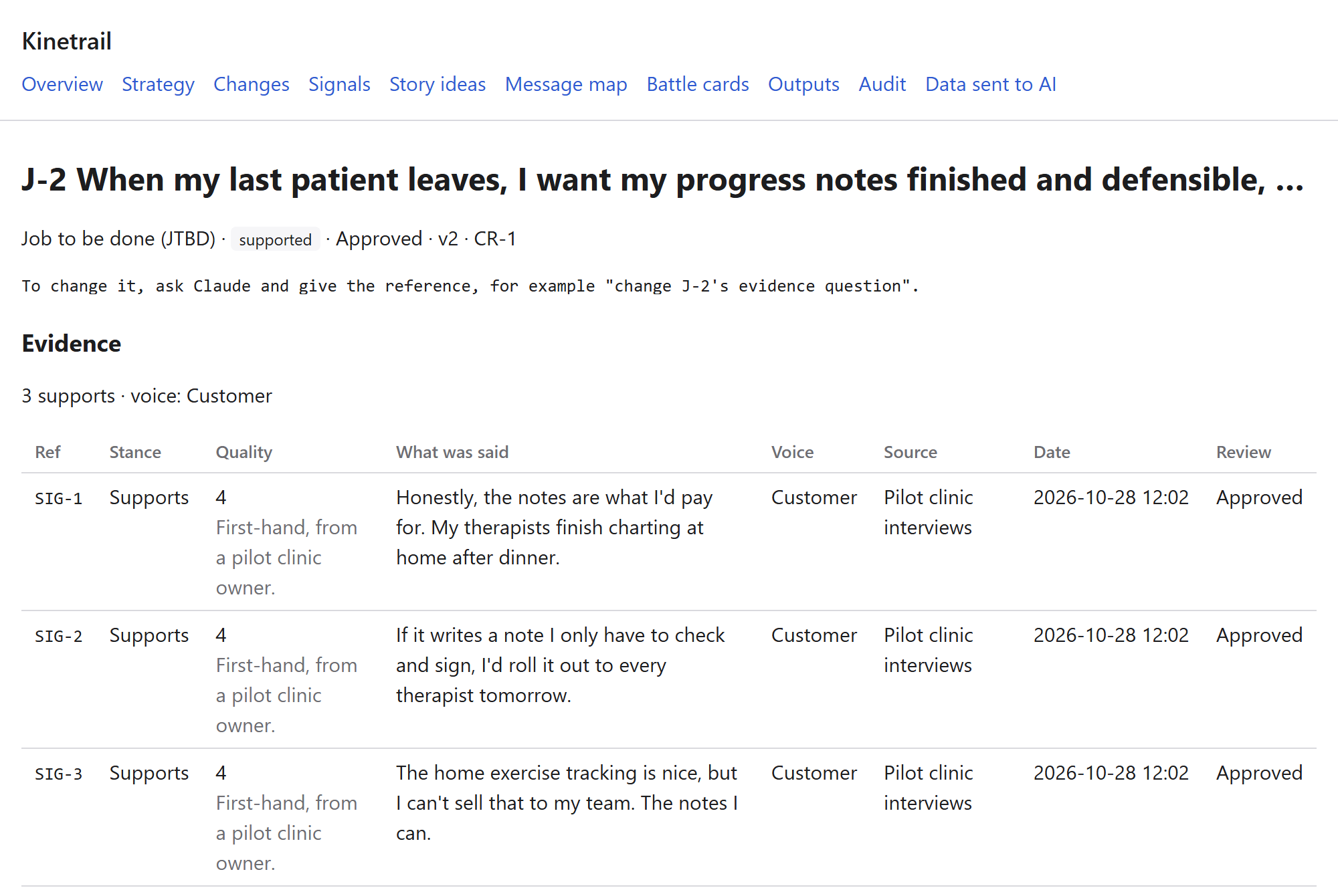
- Answer "why do we say this?" with the decision and the customer quotes behind it.
- Bring a co-founder, a new hire or an investor up to speed on how your strategy got here.
- Stop re-arguing settled decisions, and pick up the postponed ones on time.
It's a reliable memory from day one. Spotting patterns across many decisions needs many decisions, so that part grows with use.
See a job's history in the example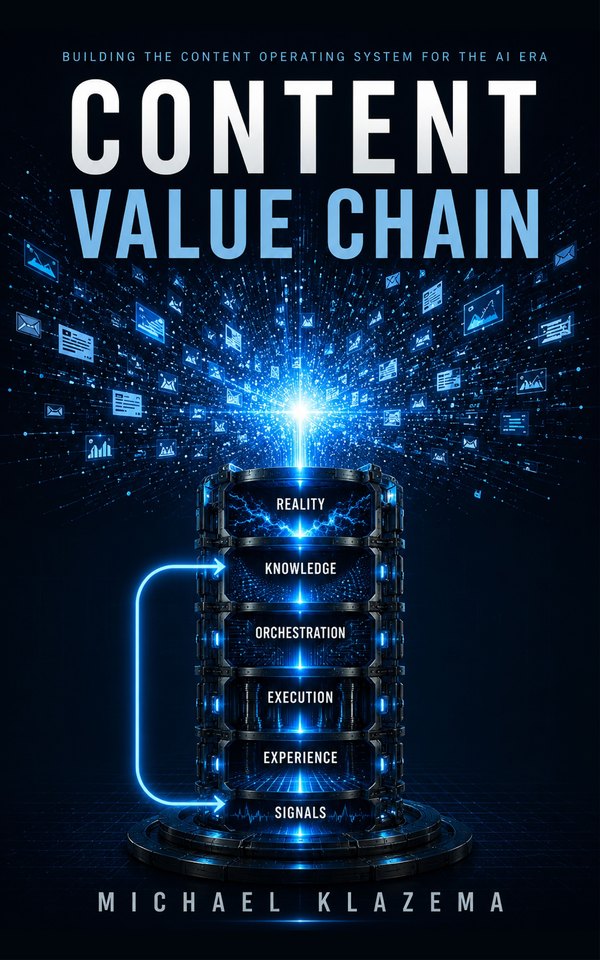
Built on The Content Value Chain
The book is the theory. Contexl is the working proof.
The Content Value Chain by Michael Klazema describes how business knowledge is structured, governed, put to work and improved through experience. Contexl applies it to go-to-market: the drift loop, the control loop and the Variant Ledger all come from the book.
About the bookWho it's for
Funded pre-seed B2B software founders
You've raised your first round, you're doing founder-led GTM, and there's no GTM engineer to keep your strategy, content and sales material in line. You need to learn fast and show it.
Not for you if you already run a CDP and a RevOps department, or if only consumers pay for your product: Contexl is built for selling to businesses.
FAQ
Why not just build it yourself?
Won't the context just go stale?
Your strategy doesn't wait for someone to remember it: new evidence arrives as a proposed change, with everything it touches.
Honest limit: someone still brings the signals in; the weekly competitor analysis covers one source.
Doesn't only a technical person update it?
You change your strategy by telling Claude. Contexl checks the change, shows its impact and records it.
Honest limit: it needs Claude Code, and we're still testing it with non-technical founders.
Can't a folder of Markdown files do this?
Files can't hold relationships. Contexl is one database of connected parts, with one vocabulary.
Won't AI errors spread to everything?
Nothing an AI writes counts until you approve it, and an audit checks every link.
Who brings the judgment?
It comes with it: definitions and a method from The Content Value Chain.
Honest limit: some definitions are still being refined.
Who maintains it?
You don't maintain it, you update it like any app. Your data stays one file you can back up.
Isn't a local tool just DIY?
Local is where it runs, not who builds it. Contexl is maintained software; the file is yours.
Do I need to be technical?
No. Claude Code sounds technical, but in the desktop app it's a chat window. Contexl's setup step checks what it needs (Python and git) and explains how to install anything missing.
Where is my data?
In one file on your computer. What you work on goes to Anthropic through your own Claude plan, as with anything you do in Claude. Contexl itself receives nothing.
Which AI does it use?
Yours: Claude, through your own subscription. Contexl brings no AI of its own.
What if Claude changes?
Your data stays readable and exportable without Contexl, and Contexl's commands are plain Python, so they don't depend on one AI.
Early founders
Be one of the first founders we work with closely
Contexl is new. We're looking for a small group of founders to run it on their real strategy, tell us what works and what doesn't, and shape what comes next. You get early access to Core and direct time with Michael.